

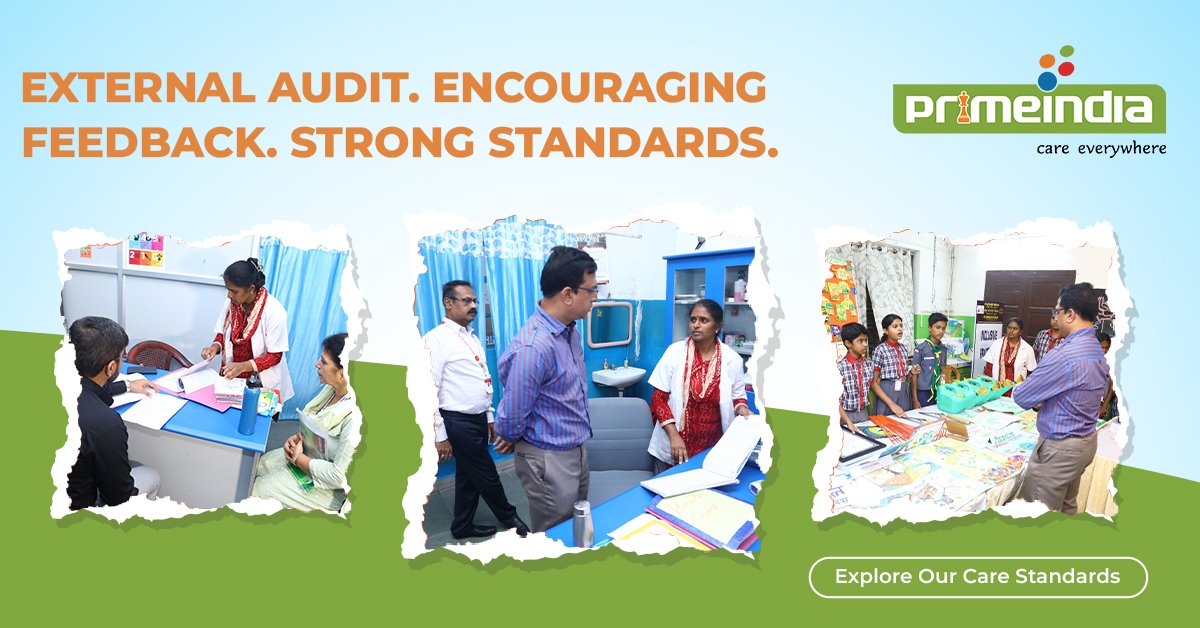
At Prime India Foundation, quality is not a milestone to be achieved once and moved past—it is a living commitment that guides every decision, every process, and every interaction. In the healthcare space, where trust is fragile and impact is deeply personal, maintaining consistent quality is not optional; it is fundamental.
With this philosophy at the core of our work, we recently undertook an external audit at our clinic premises. The objective was not merely to validate compliance, but to critically assess whether our systems, services, and practices truly reflect the standards we promise to the communities we serve.
We are pleased to share that the overall feedback from the audit was highly encouraging, reaffirming the strength of our operational framework and the integrity of our service delivery.
Why External Audits Matter in Healthcare
Healthcare is a sector where intent alone is never enough. Good intentions must be supported by measurable standards, accountable processes, and regular evaluation. External audits play a crucial role in this ecosystem by providing an independent, unbiased assessment of how healthcare services are delivered on the ground.
For Prime India Foundation, undergoing an external audit is not a compliance-driven exercise—it is a learning process. It allows us to step outside our internal perspective and view our operations through a professional, objective lens. This helps us identify strengths, address gaps, and continuously evolve our approach to care.
In an environment where healthcare access and quality often vary widely, such evaluations help ensure that services remain safe, ethical, consistent, and aligned with best practices.
Scope of the Audit
The external audit conducted at our clinic premises was comprehensive in nature. It covered multiple dimensions of healthcare delivery, including:
-
Operational processes and workflows
-
Service delivery standards
-
Hygiene and sanitation protocols
-
Patient-care practices
-
Staff preparedness and coordination
-
Overall clinic environment and accessibility
Each of these elements plays a critical role in shaping patient experience and outcomes. Rather than focusing on isolated parameters, the audit examined how these components function together as a system.
Key Observations and Positive Outcomes
The feedback received from the audit reinforced several areas that Prime India Foundation has consistently prioritized.
1. Consistency in Service Quality
One of the strongest affirmations from the audit was the consistency observed in service delivery. From patient intake to consultation and follow-up, processes were found to be structured, repeatable, and reliable.
Consistency is often the most challenging aspect of healthcare delivery, especially in resource-constrained or high-demand environments. This validation reassures us that our systems are not person-dependent but process-driven, ensuring continuity of care irrespective of variables.
2. Strong Adherence to Healthcare Standards
The audit noted our alignment with established healthcare norms across hygiene, safety, and clinical practices. Protocols related to cleanliness, equipment handling, and patient interaction were found to be well-defined and effectively implemented.
Adherence to standards is not just about meeting benchmarks—it is about reducing risk, ensuring safety, and building long-term trust. This feedback reinforces our belief that structured governance and disciplined execution are non-negotiable in healthcare.
3. A Patient-First Approach
Perhaps the most meaningful takeaway was the emphasis on patient-centricity. The audit observed that care delivery at the clinic goes beyond clinical interaction, extending into how patients are received, guided, informed, and supported.
A patient-first approach is reflected not only in medical outcomes but also in dignity, empathy, and clarity of communication. This recognition resonates deeply with our mission, as we believe healthcare should be as humane as it is effective.
The Role of Teams and Systems
While audits often highlight outcomes, behind every positive outcome lies a network of people and processes working in alignment. The encouraging feedback reflects the collective effort of our medical professionals, operational staff, coordinators, and support teams.
It also underscores the importance of having clearly defined systems—standard operating procedures, checklists, documentation, and review mechanisms—that enable teams to function cohesively. At Prime India Foundation, we invest consciously in building such frameworks because sustainable impact is impossible without operational clarity.
Quality as a Continuous Journey
Receiving positive feedback from an external audit is reassuring, but it is not an endpoint. In fact, it sets a higher responsibility.
Quality in healthcare is dynamic. Patient needs evolve, standards advance, and expectations rise. What is considered best practice today may become baseline tomorrow. Recognizing this, we view the audit outcome as both validation and motivation—to refine further, improve continuously, and anticipate future requirements.
Every insight gained from the audit feeds into our internal review cycles. Areas of strength are reinforced, while opportunities for improvement are translated into actionable steps. This cycle of evaluation and enhancement is what allows quality to remain relevant and resilient.
Building Trust Through Transparency
Transparency is a cornerstone of credibility, especially for organizations working in the social and healthcare domains. By openly acknowledging external evaluations and their outcomes, we aim to build trust with stakeholders—patients, partners, institutions, and the wider community.
Trust is not built through claims alone; it is built through accountability. External audits help bridge this gap by offering reassurance that services are not only well-intentioned but also well-executed.
Looking Ahead
As Prime India Foundation continues to expand its healthcare initiatives, the learnings from this audit will serve as a foundation for scaling responsibly. Whether it is extending services to new locations, partnering with institutions, or strengthening existing clinics, quality assurance will remain central to every decision.
Our vision is not merely to provide healthcare services, but to create reliable healthcare ecosystems—where standards are upheld, people feel safe, and care is delivered with integrity.
Conclusion
The recent external audit at our clinic premises stands as a meaningful affirmation of the path we are on. It reflects consistency, adherence to standards, and a deeply rooted patient-first philosophy.
Quality does not stand still.
It grows through reflection, evaluation, and commitment.
And at Prime India Foundation, it continues to evolve—serving not just as a benchmark, but as a promise we renew every day.